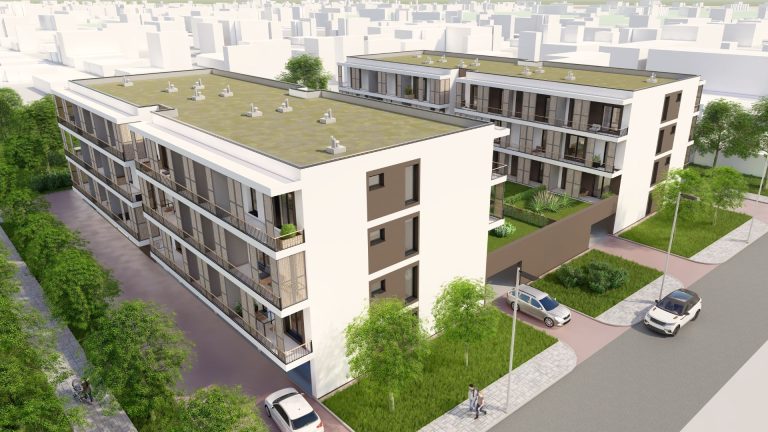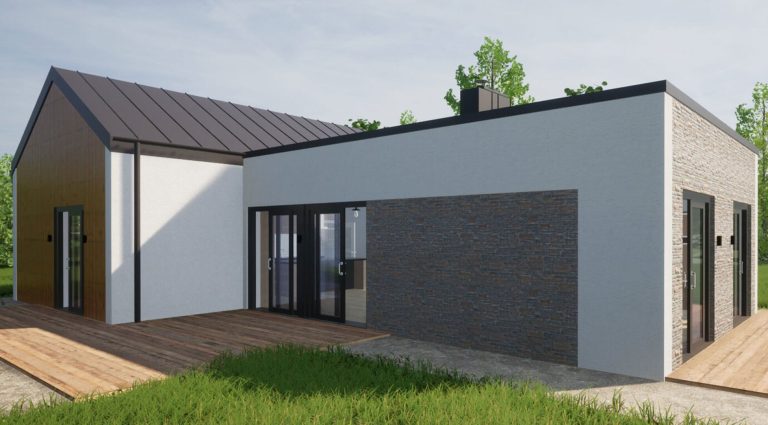
As an architect, you are looking for a material that offers you maximum design freedom while ensuring the feasibility of your design. LGSF offers both — plus the precision that traditional materials cannot provide.
Why architects are switching to LGSF
1. Design flexibility
The high strength-to-weight ratio of steel profiles enables:
- Long spans without intermediate supports — open layouts, loft spaces
- Large glazed areas — steel frames carry loads that masonry cannot support
- Unconventional shapes — CNC manufacturing allows curved and custom profiles
- Thin walls — 150–200 mm vs. 400–500 mm in masonry = more usable floor area
- High-rise buildings — LGSF systems enable constructions up to 15 storeys
2. Accuracy: Design = Reality
This is probably the greatest advantage of LGSF for architects. CNC roll-forming machines produce profiles with ±0.5 mm accuracy. This means:
- What you design in BIM is exactly what you get on site
- No on-site "adjustments"
- Precise fitting of windows, doors, façade systems
- Elimination of claims due to inaccuracies
Accuracy comparison: - LGSF: ±0.5 mm (CNC) - Wood: ±2–5 mm - Masonry: ±10–20 mm - Concrete: ±5–10 mm
3. BIM integration
LGSF is naturally compatible with BIM workflows:
- Revit/ArchiCAD plugins — direct export to production data
- Clash detection — digital model identifies clashes before construction
- Accurate costing — BIM model = precise material budgeting
- Trade coordination — HVAC, electrical, ventilation coordinated within the model
- As-built documentation — digital twin of the building
4. Adaptive reuse
Unlike concrete, where remodeling means costly demolition, LGSF allows:
- Easy renovations and extensions
- Layout changes without affecting the load-bearing structure
- Disassembly and relocation of entire buildings
- Material recycling at end of life
Technical parameters for design
| Parameter | Value |
|---|---|
| Profile thickness | 0.8–2.5 mm |
| Material | Galvanized steel S350–S550 |
| Profile height | 89–305 mm |
| Max. span (ceiling beam) | 8–12 m |
| Max. building height | 15 floors |
| Fire Resistance | REI 30–120 |
| Thermal resistance of wall | R > 6 m²K/W |
| Sound insulation | Rw > 55 dB |
| Manufacturing accuracy | ±0.5 mm |
Typical LGSF wall assembly
External wall (from outside to inside): 1. Façade cladding (any type — plaster, cladding, wood, metal) 2. Air gap + diffusion membrane 3. Thermal insulation (mineral wool 100–200 mm) 4. Steel C/U profile (load-bearing structure) 5. Vapor barrier 6. Installation lining wall (optional) 7. Plasterboard (1–2 layers)
Total thickness: 150–250 mm (vs 400–500 mm for masonry)
How to start designing with LGSF
Step 1: Contact Skymax Living
Our technical team will provide you with: - Consultation for your project - Technical documentation and details - BIM libraries for Revit/ArchiCAD - Reference projects and case studies
Step 2: Design in BIM
Design your building in BIM using LGSF profiles. Our team will review structural calculations and optimize the design for manufacturing.
Step 3: Production and assembly
Manufacturing data for CNC machines is generated from the BIM model. Panels are produced in the factory and delivered to the site. Assembly of the structural frame of a family house takes 3–5 days.
Architects section on the Skymax Living website
In Preparationprotected section for architects with access to: - Complete technical details and sections - BIM libraries and models - Certificates and approvals - Reference projects with photos - Calculation tools
Register for access and get everything you need for designing with LGSF.