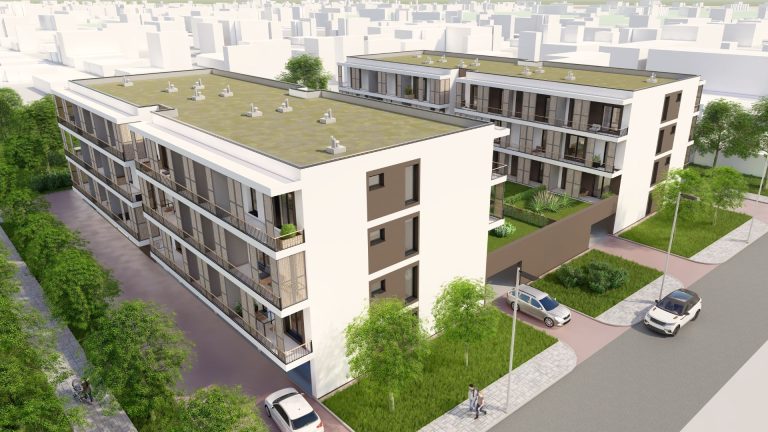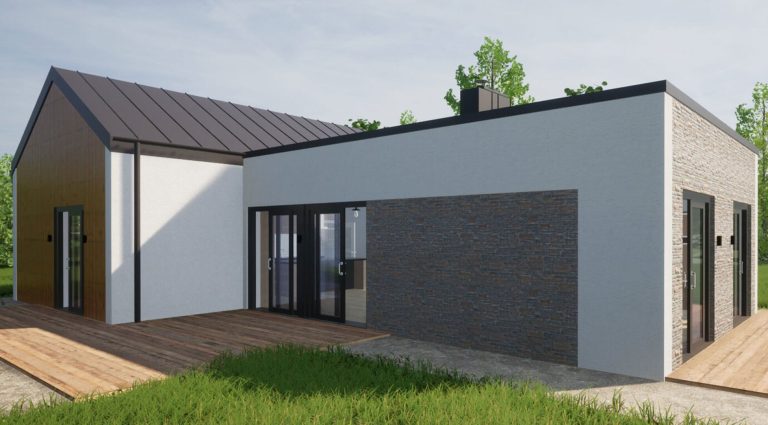
LGSF (Light Gauge Steel Frame) is not a new technology — it has been used worldwide for decades. In the USA, Australia, New Zealand, Japan, and increasingly in Europe, it is thedominant construction method for both residential and commercial buildings. In the Czech Republic and Central Europe, it is still a relatively new approach, but the adoption rate is accelerating dramatically.
What exactly is LGSF?
LGSF is a structural system based on light gauge galvanized steel profiles (thickness 0.8–2.5 mm), cold-formed on CNC machines. These profiles are assembled into panels — wall, ceiling, and roof — which form the building’s load-bearing structure.
Unlike traditional “wet” construction (masonry, concrete), LGSF is dry assembly. No waiting for drying, no wet construction processes, no weather dependency. The building is assembled from precisely manufactured components — similar to car assembly in a factory.
Key fact: The manufacturing precision of LGSF profiles is ±0.5 mm. This is a level of accuracy that traditional masonry can never achieve.
Why the world’s largest companies are switching
ArcelorMittal — the world’s largest steel producer
ArcelorMittal, holding a 24.5% share of the global high-quality steel market, actively invests in LGSF solutions through its Constructalia division. Their XCarb™ program delivers “green steel” produced from recycled material using renewable energy.
FRAMECAD — leader in LGSF technology
New Zealand company FRAMECAD has developed a complete ecosystem — from design software through roll-forming machines to assembly systems. Their customers build worldwide, from New Zealand through the USA to the Middle East.
Howick — pioneer of automation
Howick, also from New Zealand, manufactures FRAMA™ roll-forming machines that produce steel frames with ±0.5 mm precision. Their customers report 50% time savings compared to wooden structures.
Etex — European giant
Belgian group Etex (parent company of Rigips/Siniat) is actively acquiring LGSF companies in the UK and Ireland — a sign that even traditional construction giants see the future in steel frames.
Numbers that speak for themselves
| Parameter | LGSF | Masonry | Concrete | Wood |
|---|---|---|---|---|
| Construction Speed | 3× faster | 1× (reference) | 1.5× slower | 1.5× faster |
| Manufacturing accuracy | ±0.5 mm | ±10–20 mm | ±5–10 mm | ±2–5 mm |
| Structural weight | 25–35 kg/m² | 200–400 kg/m² | 300–500 kg/m² | 40–60 kg/m² |
| Construction waste | less than 2 % | 15–25 % | 10–20 % | 15–20 % |
| Recyclability | 100 % | partial | difficult | partial |
| Fire Resistance | REI 30–120 | REI 60–180 | REI 60–240 | REI 15–60 |
| Service life | 50–100+ years | 50–100+ years | 50–100+ years | 30–80 years |
Global LGSF Market
The LGSF construction market reached a value of 31.7–43.6 billion USD in 2025 and is growing at a rate of 5–8% annually. By 2030, it is expected to reach 57–71 billion USD. The European market alone accounts for over 6 billion USD.
Key Growth Factors:
- Housing crisis in the EU — a shortage of up to 10 million homes, modular LGSF construction is the fastest solution
- EU Green Deal — climate neutrality target by 2050, steel is 100% recyclable
- Labor shortage — LGSF requires fewer skilled workers
- Rising energy costs — LGSF buildings are 5–6× more energy efficient than concrete
How LGSF works in practice
1. Design in BIM
The entire structure is designed in BIM software (Building Information Modeling). Every profile, every joint, every opening is digitally defined with precision. This eliminates errors on site and enables accurate material calculation.
2. Factory production
CNC roll-forming machines produce all profiles according to the digital model. Profiles are labeled and packaged in assembly order. Production waste is minimal — less than 2%.
3. On-site assembly
Prefabricated panels are delivered to the site and assembled. No cutting, no drilling — everything is pre-prepared. The rough construction of a family house takes 3–5 days.
4. Finishing
Insulation, plasterboard, facade, and other layers are applied to the steel structure. The result is visually indistinguishable from traditional construction but with significantly better technical parameters.
Who is LGSF ideal for?
For architects: Maximum design flexibility, long spans, open layouts. BIM compatibility. Design accuracy = construction accuracy.
For developers: Faster return on investment. Fewer workers, shorter construction time, lower risk of delays. LEED certification increases property value.
For end customers: Better house for less money. Lower energy bills. No mold, no pests. Fire safety. Resistance to natural disasters.
For builders: Easy transition from traditional methods. Less waste, less on-site labor, higher margins.
Skymax Living and LGSF
Skymax Living is a Czech company specializing in LGSF systems and Flexi Panel technology. Our production capacity covers all of Europe — from family houses and terraced developments to commercial buildings. We collaborate with architects, developers, and construction companies on projects of any scale.
Want to learn more? Contact us for a non-binding consultation.